Melting Glaciers: Part 4 :Kashmir’s Hoksar Glacier melting more at top than bottom
-
 Abid Bashir
- Comments 0
- 07 May 2026
Unusual melt pattern – thin debris, black carbon, warmer air – stuns scientists STUDY’S KEY FINDINGS • Higher altitudes lose −1.44m yearly • Thin debris speeds melt, thick protects • Black carbon: 105-959 ng/m³ (among Himalayan highest) • Equilibrium line rose from 4022m to 4062m (2013-2018) • Warming temperatures + declining snowfall
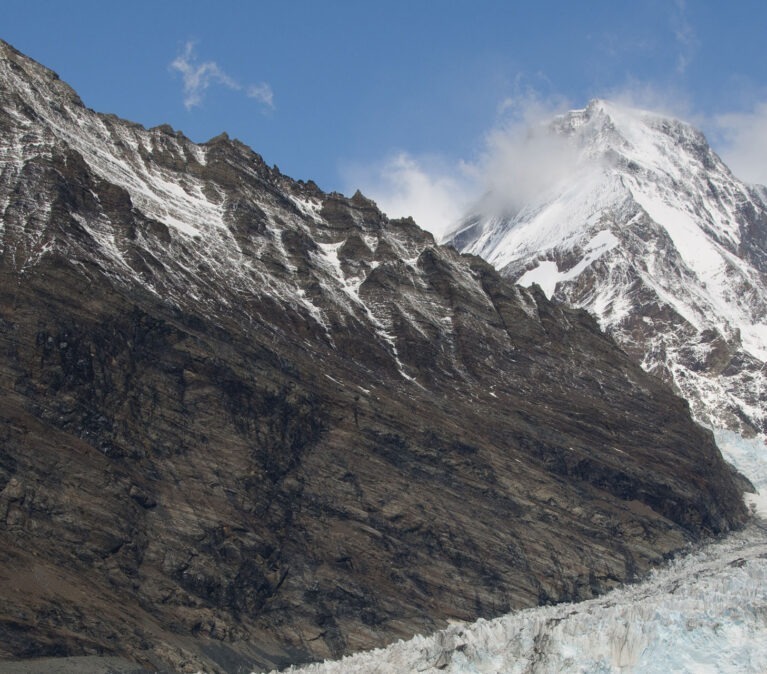
Srinagar, May 06: A scientifically significant finding has revealed that the Hoksar Glacier in Kashmir is melting faster at higher altitudes—defying the long-held belief that glacier melting decreases with elevation. Debris cover, black carbon and warming temperatures have created complex melting dynamics for the Hoksar Glacier, reveals the study done by the Kashmir University.
The research states that traditionally, glaciers lose more mass at lower elevations where temperatures are higher. However, the Hoksar Glacier presents an unusual pattern. The study led by Professor Shakil Romshoo and his team, comprising Khalid Omar Murtaza and Tariq Abdullah, found that areas at higher elevations within the ablation zone recorded greater mass loss (up to −1.44 meters water equivalent) compared to lower zones.
“This counterintuitive trend is primarily due to variations in debris thickness across the glacier surface,” the study explains.
The glacier is heavily debris-covered, with nearly 80 per cent of its ablation zone blanketed by rock fragments and boulders. “This debris layer plays a dual role. Thick debris—averaging around 20 cm—acts as an insulating layer, reducing melting. In contrast, thinner debris layers—often less than 7 cm—enhance melting by absorbing more solar radiation and transferring heat to the underlying ice,” the study reads. “As a result, higher-altitude zones with thinner debris are melting faster than lower areas with thicker protective layers. Thin debris cover increases melt rates due to higher absorption of solar radiation, while thick debris suppresses melting.”
The study also highlights the role of black carbon pollution, which further accelerates melting. “Measurements taken during field expeditions showed black carbon concentrations ranging from 105 to 959 ng/m³, significantly higher than levels reported in many other Himalayan regions. These particles reduce the albedo of the glacier surface, causing it to absorb more heat and melt faster,” the study reveals.
In addition to debris and pollution, rising temperatures have intensified the glacier’s mass loss. Data from the nearby Pahalgam meteorological station shows a consistent warming trend over the past four decades. At the same time, snowfall has declined, further reducing the glacier’s ability to replenish itself.
The study also documents a steady upward shift in the glacier’s equilibrium line altitude (ELA), which rose from 4022 meters in 2013 to 4062 meters in 2018. This shift reflects a growing imbalance between accumulation and melting. “The rising ELA is a clear signal that the glacier is losing mass and retreating,” the study observes.
Beyond its scientific significance, the research has important implications for regional hydrology. Glaciers in the Himalaya play a critical role in sustaining river systems that support millions of people.
Initially, increased melting may lead to higher river flows. However, as glacier mass diminishes, water availability is expected to decline, posing risks to agriculture, hydropower, and drinking water supply.
The study emphasises that debris-covered glaciers behave differently from clean-ice glaciers, making them more challenging to model and predict. “The regulating mechanisms of debris-covered glaciers are complex and cannot be explained by conventional elevation-based models alone,” the researchers conclude.
Calling for urgent scientific attention, the authors stress the need for long-term, high-resolution observations to better understand glacier-climate interactions in the region. As climate change accelerates, the story of the Hoksar Glacier serves as a stark reminder that even the high-altitude ice reserves of the Himalaya are far from stable—and their fate is closely tied to the future of water security across South Asia.
Related Posts
-

J&K’s Ranji win proud moment: PM Modi
-

Jammu Marathon symbolises J&K’s transformation: LG Sinha
-

Physical fitness integral to societal progress: CM Omar
-

J&K dairy grows 15%, but 7.4% samples fail safety tests
-

Kashmir’s rooftops power new energy dawn
-

Payroll Without Purpose
-

Self-styled journalists misusing platform, MLA Uri in assembly
-

Omar Abdullah urges ceasefire, calls on PM Modi to mediate Iran crisis
-

LG Sinha suspends Anantnag ADC, reassigns officer to Div Com Kashmir
-

LG, CM greet people on Mahavir Jayanti
-

J&K Govt orders transfers, postings
-

Govt to review District Planning Boards framework
-

150th Anniversary Closing Ceremony : Vande Mataram our identity, strength & vow: LG Sinha
-

Mission YUVA should become national benchmark: CM
-

LG assents to three Bills passed by LA

Leave a comment