Melting Glaciers: Part 3:Hoksar Glacier losing nearly a metre of ice each year
-
 Abid Bashir
- Comments 0
- 06 May 2026
KU STUDY HIGHLIGHTS • Upper Indus Basin at risk • Sustained mass loss confirmed • 2000-2012 saw steepest decline • Summer temps driving melt • Water security, agriculture at risk • Urgent policy action required
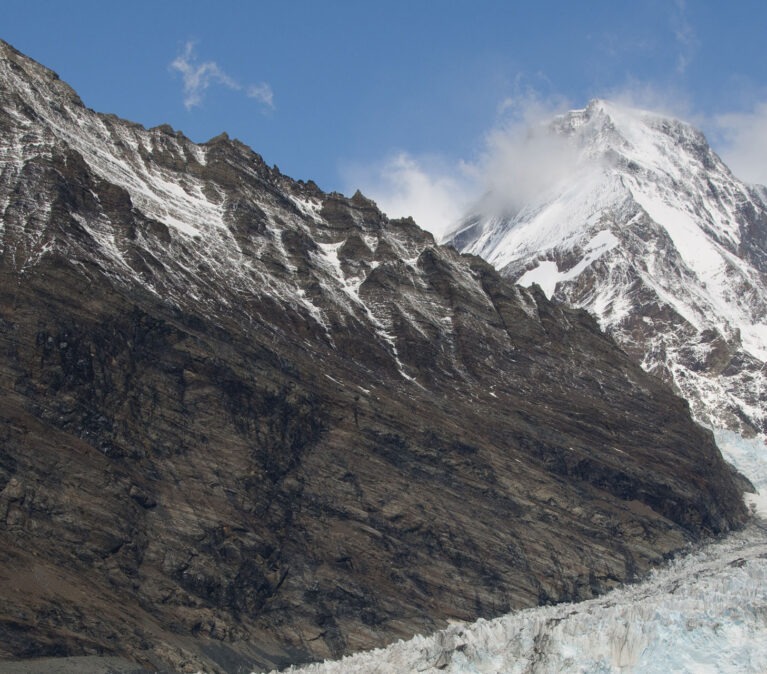
Srinagar, May 05: A comprehensive scientific study by the University of Kashmir (KU) has raised serious concerns about the future of water resources in the Upper Indus Basin, revealing that the Hoksar Glacier in south Kashmir is undergoing rapid and sustained ice loss driven by climate change and environmental stressors.
The study, published in Scientific Reports, led by Prof Shakil Romsho and his team comprising Khalid Omar Murtaza and Tariq Abdullah, combines five years of field-based observations (2013–2018) with satellite-derived geodetic analysis, offering one of the most detailed assessments of glacier health in the region.
According to the findings, the glacier recorded a mean annual mass balance of −0.95 ± 0.39 meters water equivalent, indicating consistent and significant loss of ice mass. Earlier data from 2000 to 2012 shows an even steeper decline of −1.20 ± 0.35 meters annually.
“The continuously negative mass balance observations indicate that the Hoksar Glacier is losing mass at a higher rate than several other Himalayan glaciers,” the study notes, underscoring the glacier’s vulnerability.
Situated in the Jhelum sub-basin, the Hoksar Glacier is a relatively small but hydrologically critical glacier that feeds the Lidder River, a key tributary supporting agriculture, drinking water supply, and hydropower generation. Scientists warn that its accelerated melting could disrupt downstream water availability, especially during dry seasons when glacier melt contributes significantly to river flow.
The research highlights a steady increase in temperatures across the region, with mean annual temperatures rising at a rate of 0.05°C per year between 1980 and 2018. This warming trend, coupled with declining snowfall, has significantly altered the glacier’s mass balance.
“While total precipitation has not shown a significant trend, its form has changed from snow to rainfall, reducing accumulation on the glacier,” the authors explain.
Reduced snowfall means less replenishment of glacier mass during winters, intensifying the imbalance between accumulation and melting.
Another critical factor identified in the study is the rising concentration of black carbon—tiny soot particles from fossil fuel combustion and biomass burning. These particles settle on the glacier surface, reducing its reflectivity and increasing heat absorption.
The study records a sharp rise in black carbon levels in the region, from around 90 ng/m³ in 1980 to 235 ng/m³ in 2017. “This increase in black carbon concentration has significantly contributed to atmospheric warming and enhanced glacier melt,” the researchers state.
The study also points to a concerning shift in the glacier’s equilibrium line altitude (ELA)—the point where accumulation equals melting—which has moved upward by about 40 meters between 2013 and 2018. This upward shift is a clear indicator of glacier imbalance and retreat.
Experts caution that while increased melting may temporarily boost river flows, the long-term consequences could be severe. As glacier mass continues to decline, water discharge is expected to decrease, posing risks to irrigation, energy production, and overall water security in the basin.
“The mass loss of glaciers has already begun to impact streamflow, and continued loss could adversely affect water availability for food, energy, and other essential sectors,” the study warns.
Given the importance of the Himalaya—often referred to as the “Third Pole”—in sustaining river systems across South Asia, the findings carry implications far beyond Kashmir.
The authors emphasise the urgent need for long-term monitoring and integrated climate-glacier studies to better understand ongoing changes. “Sustained mass balance and hydro-meteorological observations are crucial to developing strategies for sustainable water resource management in the region,” the study concludes.
Related Posts
-

J&K’s Ranji win proud moment: PM Modi
-

Jammu Marathon symbolises J&K’s transformation: LG Sinha
-

Physical fitness integral to societal progress: CM Omar
-

J&K dairy grows 15%, but 7.4% samples fail safety tests
-

Kashmir’s rooftops power new energy dawn
-

Payroll Without Purpose
-

Self-styled journalists misusing platform, MLA Uri in assembly
-

Omar Abdullah urges ceasefire, calls on PM Modi to mediate Iran crisis
-

LG Sinha suspends Anantnag ADC, reassigns officer to Div Com Kashmir
-

LG, CM greet people on Mahavir Jayanti
-

J&K Govt orders transfers, postings
-

Govt to review District Planning Boards framework
-

150th Anniversary Closing Ceremony : Vande Mataram our identity, strength & vow: LG Sinha
-

Mission YUVA should become national benchmark: CM
-

LG assents to three Bills passed by LA

Leave a comment