NIT Srinagar hosts lecture on Raman Spectroscopy
-
 RK News
- Comments 0
- 06 May 2026
Srinagar, May 05: The National Institute of Technology (NIT) Srinagar on Tuesday organized a high-profile invited lecture on "Raman Spectroscopy: Transforming Research Across Scientific Fields."
The event was conducted as part of the outreach activity of the Indian National Young Academy of Science (INYAS), in collaboration with the University of Kashmir and IIT Jammu.
The lecture was delivered by distinguished scientist Prof. Chandrabhas Narayan, from Chemistry and Physics of Materials Unit at Jawaharlal Nehru Center for Advanced Scientific Research (JNCASR).
The event was attended by senior faculty members, including Prof. Prince A. Ganaie, Head, Department of Physics; Prof. Kowsar Majid, Head, Department of Chemistry; Prof. Mohd Iqram; Dr. Vijay Kumar, along with other faculty members, researchers, and students.
Prof. Narayan, a renowned expert in the field, delivered a comprehensive lecture on the fundamental principles of Raman Spectroscopy and its evolution into a cornerstone of modern scientific research.
During the technical session, he offered deep insights into how Raman Spectroscopy bridges physics, chemistry, and biology, emphasizing its pivotal role in materials science, particularly in understanding molecular vibrations and nanoscale structural properties.
He began by explaining the interaction of light with matter through processes such as transmission, reflection, absorption, and luminescence.
Prof. Narayan further distinguished between elastic (Rayleigh) scattering and the rare phenomenon of inelastic scattering, which produces the characteristic “Red Shift” (Stokes) and “Blue Shift” (Anti-Stokes) discoveries that led Sir C.V. Raman to receive the Nobel Prize.
He also recounted the historic experiment in which Raman used a simple prism and sunlight to capture the first photographic evidence of this scattering phenomenon.
A major part of the lecture focused on Raman Spectroscopy as a “molecular fingerprint,” enabling the precise identification of chemical structures through molecular vibrations such as asymmetric stretching and symmetric bending.
Prof. Narayan also highlighted the significance of analyzing peak shifts to evaluate internal stress and strain in materials, along with the importance of spatial resolution and penetration depth in advanced imaging applications.
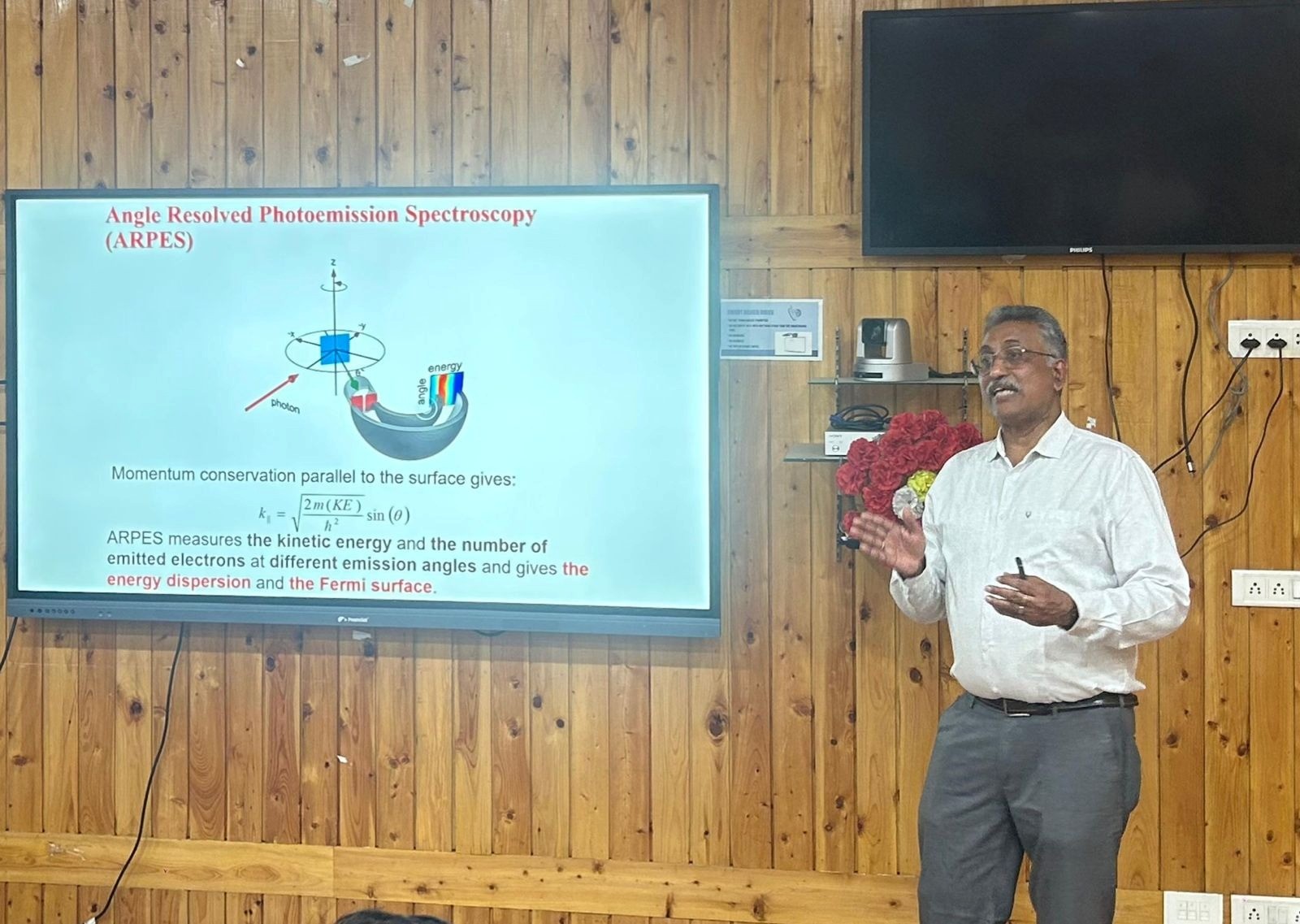
The discussion was further extended to advanced characterization techniques, particularly Angle-Resolved Photoemission Spectroscopy (ARPES).
He explained how ARPES allows scientists to directly observe the electronic structure of solids by mapping the energy and momentum of electrons, making it a powerful tool for studying complex materials and phenomena such as the Quantum Hall Effect.
He emphasized that such spectroscopic techniques are fundamental to modern condensed matter physics.
Earlier, the coordinator of the event, Dr. Vijay Kumar, welcomed the Chief Guest and stated that such lectures by eminent scientists like Prof. Chandrabhas Narayan provide valuable exposure to advanced concepts and help bridge the gap between classroom learning and cutting-edge research.
In his message, Director NIT Srinagar, Prof. Binod Kumar Kanaujia, lauded the efforts of the Department of Physics and INYAS for bringing such a high-level academic event to the campus.
“Such expert interactions play a key role in strengthening the research ecosystem, encouraging innovation, and exposing students to advanced developments in science and technology,” he said.
Institute Registrar, Prof. Atikur Rehman, also appreciated the smooth conduct of the programme and commended the coordination between collaborating institutions, including IIT Jammu and the University of Kashmir.
The event drew more than 85 attendees, including delegates from NIT Srinagar, University of Kashmir, IIT Jammu, Central University of Kashmir, and several government colleges from Srinagar and other parts of the region. The programme was anchored by Aswa Shah, who is currently interning under Dr. Vijay Kumar in the Department of Physics.
Related Posts
-

Srinagar Police Crack Down on Fake News and Misinformation Network
-

CM Omar Abdullah interacts with Religious Leaders, Civil Society amid West Asia Tensions
-

J&K Bank, LFO-BHF organize Project RISE in Srinagar District
-

Mirwaiz expresses grief over Zojila Pass avalanche tragedy
-

Big Impact Awards : Entrepreneurship is turning crises into opportunities: LG
-

Driver Killed, Two Injured in School Van Accident at Srinagar's Lal Chowk; Students Safe
-

Water supply to remain disrupted in Srinagar parts
-

Last of the Tongas': Srinagar man’s journey to keep a vanishing heritage alive
-

Reclaiming The Footpaths: SSP Traffic Sgr leads surprise drive, clears illegal occupation by mechanics
-

LPG supply delays disrupt daily life in Srinagar
-

Ceasefire a positive development for global peace: Raina
-

Massive Fire Guts Five Houses in Srinagar’s Habba Kadal
-

HCMCT Manipal Hospital organizes OPD for neurological, cancer patients in Srinagar
-
SKIMS administration assigned to H&ME
-
Youth found dead in Budgam

Leave a comment